The short answer
Start with construction.
Keep your style preferences.
Our first search route is an explicitly identified low-bridge version with documented nose support. A frame with adjustable nosepads is another route to investigate. Neither description, by itself, tells us whether a particular person will avoid cheek contact.
“Best” on this site means the most suitable documented options for a stated set of needs. It is not a universal winner. We compare the exact version, available evidence and unresolved questions before recommending a purchase.
The construction descriptions below come from the cited manufacturers. Our search order and decision checklist are editorial interpretations. They have not been validated in a comparative wear trial.
01 / The first search route
Look beyond the low-bridge label.
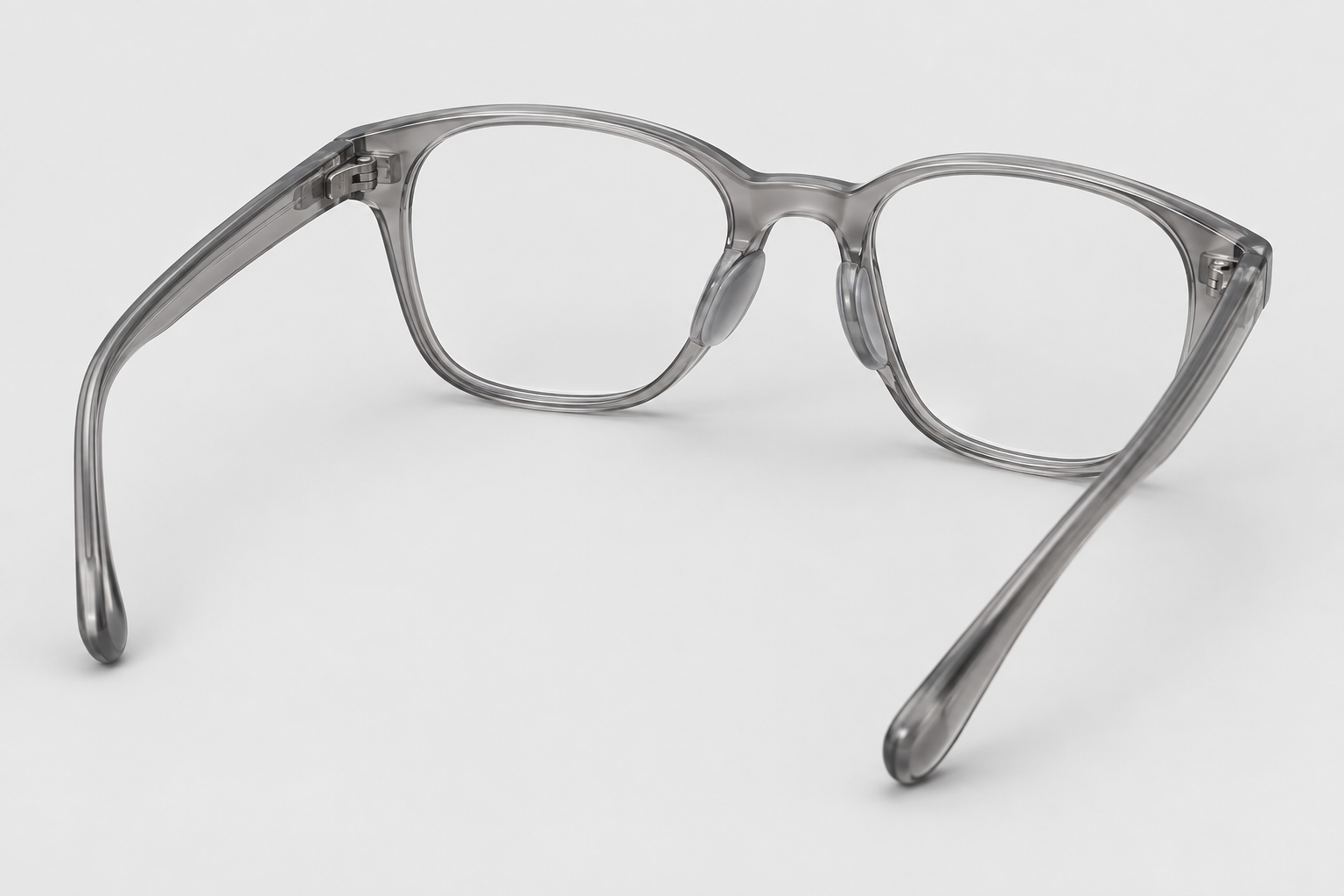
JINS describes its Low Bridge Fit as using larger integrated nosepads, while treating Adjustable Fit as a separate construction. That distinction helps identify what to inspect on a product page. It does not establish that every frame sold with a low-bridge label uses identical geometry. JINS fit guide [1]
Warby Parker describes a combination of enlarged pads, an altered lens angle and outward-curving temples in its own low-bridge designs. This supports examining several parts of the frame together, rather than treating nosepad size as the entire explanation. Warby Parker low-bridge overview [2]
Three checks on the product page
- Match the full product code. Save the model, fit suffix, color and size. Two similar photographs can describe different constructions.
- Identify the support. Read whether the pads are integrated into the frame or attached to separate arms. For a fixed design, look for a description of the enlarged support; for adjustable pads, verify that adjustment is actually documented.
- Write down what is missing. If pad height or overall width is absent, ask the retailer. Do not infer those dimensions from a perspective photograph.
Record how the bridge is supported and which parts can be adjusted. Neither support type proves cheek clearance.
What we check before including a candidate
- The precise model, color, size and fit version match the source.
- The support feature is described by a source for that version.
- Any information about lens angle or cheek clearance is attributed, rather than inferred from a front photograph.
- Missing dimensions and configuration details stay visible.
This is why a familiar brand name is not enough. A standard-fit and a low-bridge version can look similar in a small image. We keep them separate in the research inventory.
Explore low-bridge candidates ↗02 / Another support route
Adjustable pads add a fitting variable.
JINS identifies separate adjustable pads as a way to tailor nose support. Warby Parker advises professional adjustment and notes that changing pad position may help when a frame contacts the cheeks. These are fitting possibilities, not guarantees for every frame or wearer. [1] [3]
For our selection process, “adjustable” needs evidence. We do not classify a frame from material alone: metal construction does not prove an adjustable pad assembly. A fitting professional can assess whether a particular adjustment is appropriate for the frame and lenses.
What to ask at a fitting
- Can these particular pad arms be adjusted to support this frame on my nose?
- After adjustment, does the whole frame remain level, stable and clear of my cheeks?
- Are replacement pads available for this model, and who can fit them?
When this route may change the shortlist
Consider it when you prefer a frame that offers a way to alter nose support, or when a fixed support design has not suited you. Then repeat the width and cheek-contact checks. Adjustment does not supply missing size data or prove all-day comfort.
We do not provide a do-it-yourself bending procedure. Material, pad arms, lens position and frame condition differ; the intended adjustment should be assessed with the actual glasses.
Explore adjustable-pad candidates ↗03 / Read the right measurement
A lens number is only part of the picture.
Warby Parker describes its frame-width categories using the full front width. Its low-bridge frames also come in different widths. That is a reason to record total width separately from a fit label. Width explanation [4]
Use a comfortable pair as a reference
- Record its temple code. Keep lens width, bridge and temple length in separate fields. An example such as 52–18–140 does not include full front width.
- Ask for comparable total widths. Use the same endpoints and the same measurement basis for both pairs. If that information is missing, bring your current pair to a fitting instead of filling in a guessed number.
- Check both sides when worn. Note pressure at the temples and whether the frame is stable. A close width match is a starting reference, not a guarantee that bridge support will match.
Two products can have similar lens widths but different overall widths. Use the full-width measurement and its stated basis; leave it unknown if the source does not report it.
| Field | What we record | What we do not assume |
|---|---|---|
| Lens width | The published width of one lens | That it equals the overall front width |
| Total width | The full-front measure and its stated basis | That “Medium” is the same across brands |
| Weight | The value and described configuration | That a frame-only weight is a finished prescription pair |
| Price | Currency, date and included lens package | That a frame-only quote is comparable to a lens-inclusive total |
The table describes our data rules, not a formula that predicts fit. If a field is missing, the useful next step is to ask the retailer or try the frame, rather than calculate a score from an invented value.
04 / Check the whole frame on you
Support and cheek clearance
are separate questions.
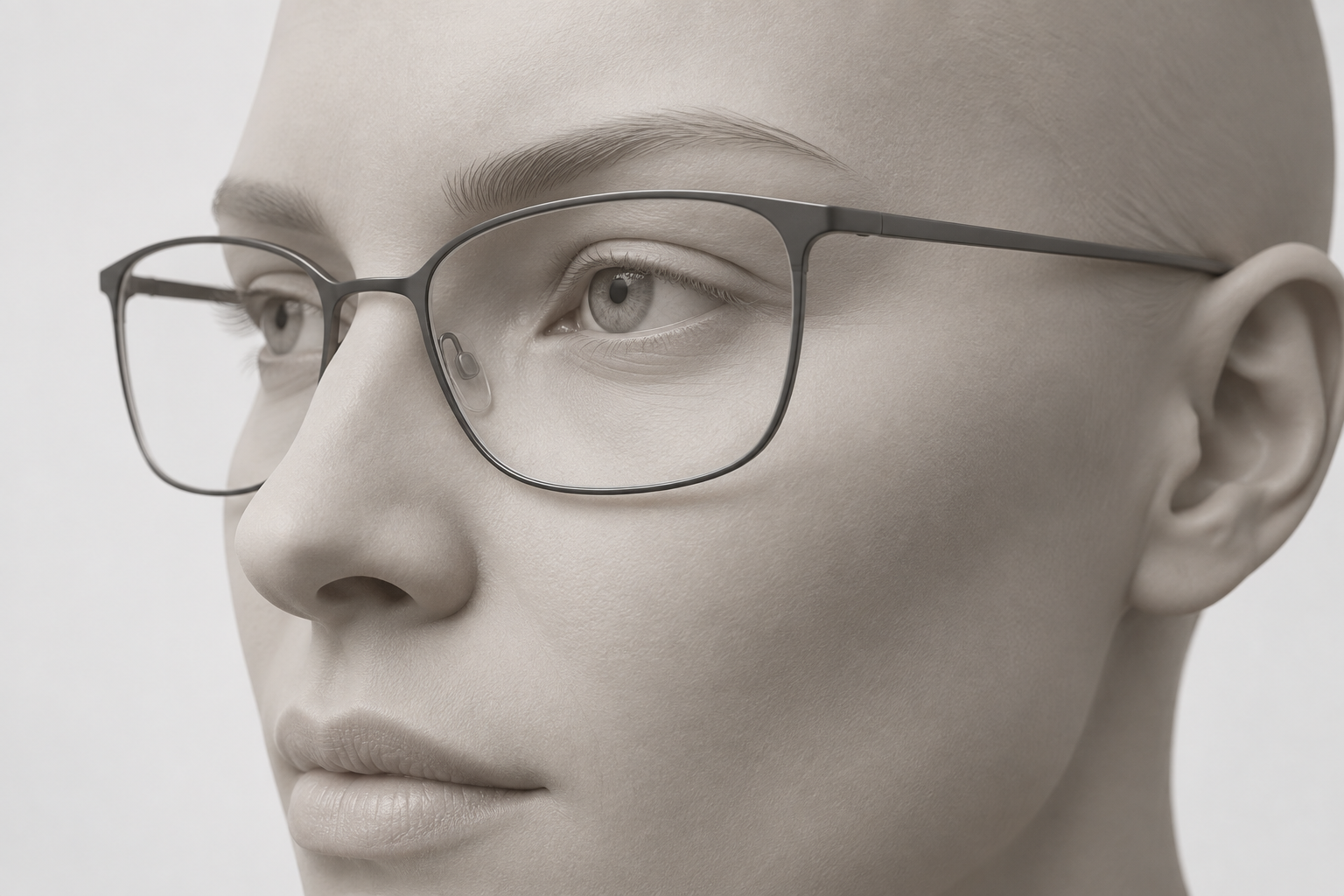
Warby Parker's general fitting guidance says frames should stay clear of the cheeks, including when smiling, and remain balanced on the nose without excessive pressure or slipping. We use these observations as practical questions for a fitting. Fitting guidance [3]
A product photograph cannot settle these questions for an individual. Nor does a positive review from a person with an unspecified face shape. During a fitting, compare the actual contact and movement with the frame's documented support design. If a problem persists after an appropriate adjustment, reconsider that exact frame.
A short check with the actual glasses
- Start at rest. With the frame fitted normally, look straight ahead. Note the contact points at your nose, cheeks and temples.
- Smile naturally. Watch whether the lower rim makes contact or moves upward with your cheeks. Do not push the frame into an artificial position to create a gap.
- Move normally. Turn your head and look down. Note repeated slipping or pressure; briefly standing still does not establish all-day comfort.
- Recheck after a professional adjustment. If the issue persists, try a different construction or size. Before prescription lenses are fitted, confirm what can still be returned.
A frame that continues to sit on your cheeks, lift with your smile or require repeated repositioning after a fitting check. We do not turn that observation into a blanket ban on round or oversized styles.
Why we do not ban an entire shape
Our current sources do not establish a universal rule that round, rectangular or cat-eye frames are unsuitable for everyone in this audience. We therefore keep shape as a preference, and make a conditional exclusion when there is a known fit problem. An absent measurement is an uncertainty, not an automatic rejection.
Save this for your fitting
A checklist you can actually use.
- Identify the version. Save the exact size, color, fit label and product code.
- Choose a support route. Confirm built-in low-bridge support or adjustable pads using the product source.
- Compare like with like. Separate overall width, lens width, weight configuration and price basis.
- Read the counterexamples. Check negative feedback, its version and the limits of the sample.
- Test the open questions. Check contact, movement and comfort with the actual frame and appropriate fitting.
- Check the transaction. Confirm lens options, current availability and return terms with the seller.
Turn the checks into a shortlist.
What the evidence cannot tell us yet.
These are manufacturer explanations and an editorial method, not independent comparative trial results. We have not measured these frames, worn the complete shortlist, or established a numerical cheek-clearance threshold. Individual results remain uncertain even when several sources or AI services give similar explanations.
Our product pages keep published facts, buyer accounts, editorial conclusions and AI interpretations separate. When those layers conflict, the conflict should remain visible rather than disappear inside a single score.
Sources and their scope.
- JINS — Eyewear fit guide
Primary manufacturer description of its fit categories; not an independent comparison.
- Warby Parker — Low Bridge Fit
Manufacturer explanation of its own construction; not evidence that every similarly labeled product is identical.
- Warby Parker — How should glasses fit?
General fitting guidance, used to frame questions rather than diagnose an individual fit.
- Warby Parker — More widths
Its own sizing approach; size-category names are not a cross-brand standard.
Sources checked September 23, 2026. Source links in this guide are ordinary links. Future eligible links may earn a commission; payment does not determine inclusion or conclusions.